 Tailoring App
Lehenga measurement chart: 15 measurements for choli and skirt, with sizes

A lehenga is the most expensive order most boutiques take, and the one with no second chance. The date cannot move, the fabric often cannot be replaced, and the choli has to fit a body that may change in the months before the wedding. A missed measurement here costs far more than one on a blouse.
This chart lists the 15 measurements for a lehenga choli, how to take each one, standard sizes, how much flare and fabric to plan for, and what shops charge to stitch one. To print a blank form with your boutique's name on it, use the free lehenga measurement form.
Before you start
- Ask for the bra and the heels. Measure the choli over the bra she will wear, and the skirt length in the heels she will wear. If she has not chosen them, write down the heel height you assumed.
- Ask where she wants the skirt to sit. At the natural waist or lower, on the hip. This is the first question, because every skirt measurement starts there.
- Standing straight, arms relaxed, breathing normally. Brides pull their stomachs in. Ask her not to.
- Snug, not tight. One finger should slide under the tape.
- Write the unit on the card, inches or centimetres.
Choli measurements
The numbers match the diagram at the top. Open the diagram to print.
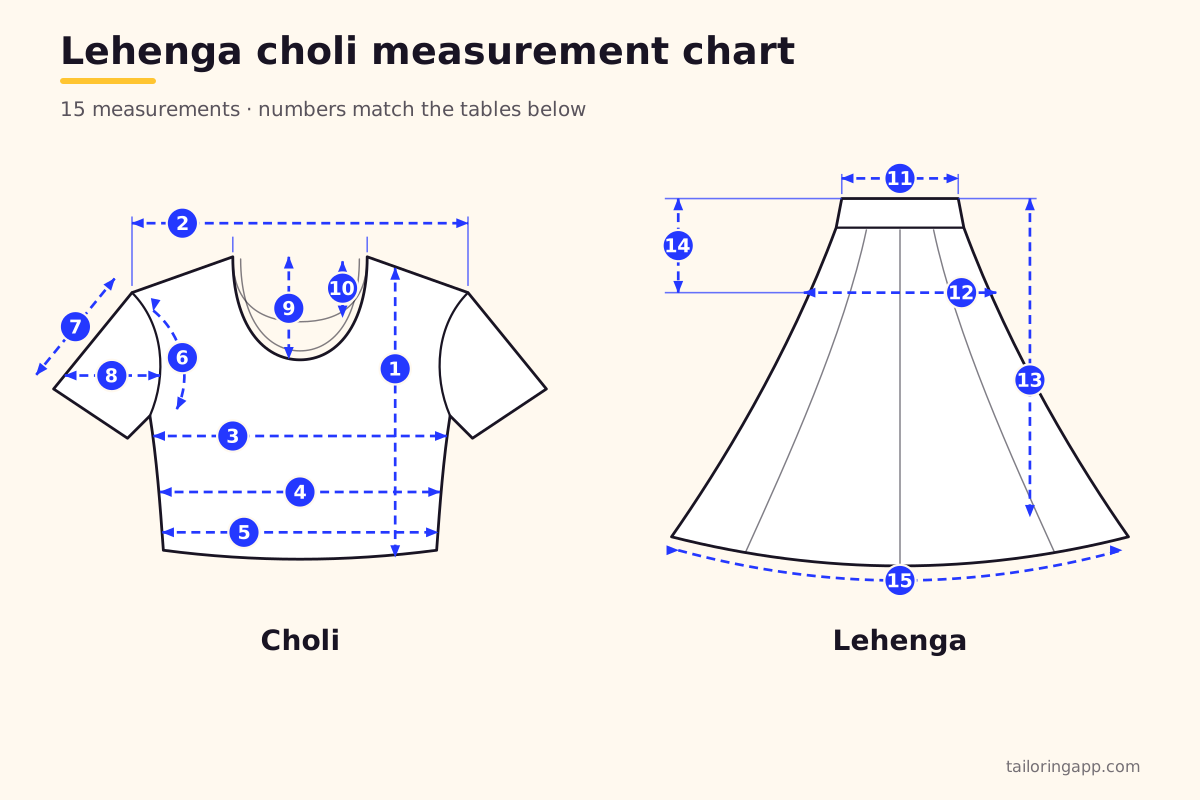
| # | Measurement | How to take it |
|---|---|---|
| 1 | Choli length | From the highest point of the shoulder, over the bust, down to where the choli should end. |
| 2 | Shoulder | Across the back, from one shoulder tip to the other. |
| 3 | Chest | Around the fullest part of the bust, tape level at the back. |
| 4 | Under bust | Around the ribcage, just under the bust. |
| 5 | Choli hem round | Around the body at the exact line where the choli will end. |
| 6 | Armhole | Around the arm at the shoulder joint, passing under the arm. |
| 7 | Sleeve length | From the shoulder tip to where the sleeve should end. |
| 8 | Sleeve round | Around the arm where the sleeve ends, plus the fullest part of the upper arm. |
| 9 | Front neck depth | From the base of the neck at the shoulder line down to where the front neckline should sit. |
| 10 | Back neck depth | From the base of the neck at the back down to where the back neckline should sit. |
Also take apex length (shoulder point to bust point) and apex to apex for a fitted choli, the same way as for a blouse. A bridal choli with cups needs both.
Lehenga skirt measurements
| # | Measurement | How to take it |
|---|---|---|
| 11 | Waist | Around the body at the place the skirt will sit. |
| 12 | Hip | Around the fullest part of the hip, usually 7 to 9 inches below the natural waist. |
| 13 | Length | From the place the skirt sits, down the side, to the floor, in her heels. |
| 14 | Waist to hip | From the place the skirt sits, down to the hip line. This tells you where the flare starts on a fitted lehenga. |
| 15 | Hem flare (ghera) | The full round at the hem. A design choice, not a body measurement. Write the number you agree on. |
Take length at the side and at the front. If she carries weight at the front, the two differ, and a hem cut from one number will not sit level.
Standard lehenga sizes
Use this table to check a number that looks wrong, or for ready stock. Brand charts differ by an inch or more, so it does not replace measuring. Indian bridal labels usually size by the bust in inches.
| Size | Chest (inches) | Waist | Hip | Lehenga length |
|---|---|---|---|---|
| XS (32) | 32 | 26 | 35 | 40 to 42 |
| S (34) | 34 | 28 | 37 | 40 to 42 |
| M (36) | 36 | 30 | 39 | 41 to 43 |
| L (38) | 38 | 32 | 41 | 41 to 43 |
| XL (40) | 40 | 34 | 43 | 42 to 44 |
| XXL (42) | 42 | 36 | 45 | 42 to 44 |
| 3XL (44) | 44 | 38 | 47 | 42 to 44 |
These are typical figures from several Indian charts, not a formal standard. A choli usually runs 14 to 15 inches long, longer for a modest cut, shorter for a crop.
Which measurements matter for each style
- Flared or A-line lehenga: waist and length. The flare clears the hip on its own.
- Circular or kalidar lehenga: waist, length and the flare you agree on, because the flare decides the fabric.
- Fishtail or mermaid: waist, hip, waist to hip, and thigh and knee rounds. Mark the point where the flare begins.
- Long choli or jacket style: add hip length and a hip round on the choli itself.
- Crop top lehenga: the choli hem round and the gap to the skirt. Agree on how much midriff shows, and write it down in inches.
Flare and fabric guide
Agree on the flare before you buy the cloth. These are rough figures for fabric about 44 inches wide and a medium size. Lay it out before you promise anything.
| Part | Fabric needed |
|---|---|
| Choli | 1 to 1.25 metres, more for long sleeves or a long choli |
| Lehenga, moderate flare (3 to 4 metre hem) | 3 to 4 metres |
| Lehenga, full flare (5 to 7 metre hem) | 5 to 7 metres |
| Bridal, very full flare (8 metres or more) | 8 metres or more |
| Lining | About the same as the skirt, or less for a panelled cut |
| Dupatta | 2.25 to 2.5 metres long, about 1 metre wide |
A heavy border adds to this because it has to be joined along the hem. Net and georgette need lining. Allow for a can-can if she wants more volume, and remember that it changes how the skirt hangs, so check the length with it on.
What shops charge to stitch a lehenga
These are stitching charges published by Indian tailoring shops and stitching services, seen in November 2026, for labour only. Few shops publish these prices, and big-city online services charge the most.
| Who | Charge |
|---|---|
| Hyderabad tailor | From about ₹1,500 for a lehenga |
| Delhi and NCR doorstep service | ₹2,750 for a lehenga choli, lining extra |
| Online retailer's stitching service | ₹5,000 for a lehenga |
| Delhi and NCR shop | ₹6,590 for a lehenga choli with can-can |
| Delhi online tailor | ₹9,200 for a lehenga, ₹12,000 for a lehenga choli |
Heavy handwork, cups, can-can and fancy dori are usually charged on top. The cost of your own lehenga work comes down to the same four things as any garment: karigar, materials, shop overheads and margin. Our tailor rate list explains how to work these out and how to price the extras.
Bridal orders: booking the work
Bridal orders fail on dates more often than on measurements. A sensible order of work:
- Booking, 2 to 3 months out where you can. Take measurements, design photos, an advance and the event date.
- First trial, on the plain garment or a muslin. Fix the choli fit before any handwork starts.
- Handwork, once the fit is right. A worked panel cannot be let out afterwards.
- Final trial, 1 to 2 weeks before the wedding. With the cups, the can-can, the heels and the dupatta draped.
- Delivery, a few days before the event. Never on the wedding morning.
Put the dates on the bill as well as in your diary. The boutique design in our bill book formats has room for the event date, two trials and a sketch.
At the trial: what to check
| Problem | Measurement to check |
|---|---|
| Choli rides up when she raises her arms | Armhole, or the choli hem round. |
| Choli gapes at the neck or back | Shoulder too wide, or the neck too deep or wide. |
| Pulls across the bust | Chest ease, apex length or apex to apex. |
| Skirt slides down | Waist taken at a different place from where she wears it. |
| Hem drags at the front | Length taken only at the side. Level it on her, in her heels. |
| Skirt falls flat | Flare, lining or missing can-can. |
| Skirt looks too heavy at the waist | Too many gathers. Use panels instead, or move gathers to the sides. |
Notes to write next to the numbers
- Choli: neck design, back design, cups, dori or hooks, sleeve style.
- Skirt: where it sits, flare, panels or gathers, lining, can-can, side zip or drawstring.
- Dupatta: how it will be draped and whether it needs pins or a hidden hook.
- Work: type of embroidery, where it goes and who is doing it.
- Heel height, the event date and the date of any function before it.
Keep it all with the order
A bridal order means numbers, photos, a karigar's dates and a trial schedule, and the slip cannot hold them all.
In Tailoring App you set up a Choli piece and a Lehenga piece once with the fields from this chart. Each measurement is saved against the customer with the date and up to three photos of the design. Trial and delivery dates show on the dashboard, and the order moves through your own stages, such as cutting, stitching, embroidery and finishing. The karigar sees the job and the photos, not the customer's name, phone number or price. It is free for one person and 50 orders a month. See how it works for boutiques.