 Tailoring App
Shirt and pant measurement chart for men: 18 measurements and standard sizes

A gents order looks easy until the customer sits down. A shirt that looked fine at the counter pulls at the stomach button, and a pant that fit standing up tightens at the seat. Nearly always, one measurement was skipped or was taken over a thick shirt or an old belt line.
This chart covers the 18 measurements a tailor needs for a men's shirt and pant, how to take each one, standard shirt and waist sizes, how much ease to add and how much fabric to ask for. To print a blank form with your shop's name on it, use the free shirt and pant measurement form.
Before you start
- Shirt off the jacket, wallet out of the pocket. Measure over a thin shirt, with nothing in the pockets.
- Standing straight, arms relaxed. Ask him to breathe normally and not pull his stomach in.
- Find where he wears his pant. Many men wear a pant below the true waist. Ask him to point to it, then measure there.
- Snug, not tight. One finger should slide under the tape.
- Write the unit on the card. Inches or centimetres, every time.
Shirt measurements
The numbers match the diagram at the top. Open the diagram to print.
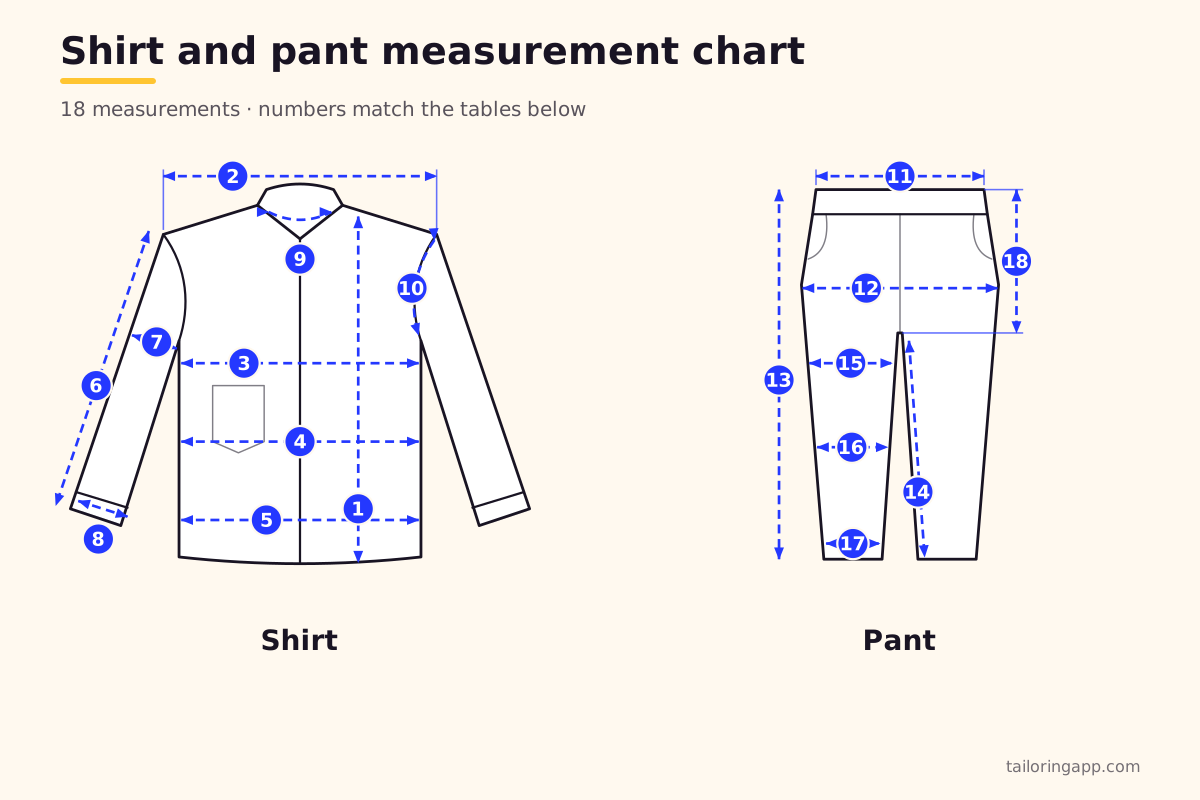
| # | Measurement | How to take it |
|---|---|---|
| 1 | Length | From the highest point of the shoulder, next to the collar, straight down to where the hem should end. |
| 2 | Shoulder | Across the back, from one shoulder tip to the other, following the curve of the back. |
| 3 | Chest | Around the fullest part of the chest, under the arms, tape level at the back. |
| 4 | Stomach | Around the fullest part of the stomach, usually at the navel. Do not skip this on a customer with a belly; it is the button that pulls. |
| 5 | Hip | Around the seat. It matters most when the shirt is worn outside the pant. |
| 6 | Sleeve length | From the shoulder tip, over a slightly bent elbow, to the wrist bone. |
| 7 | Bicep | Around the fullest part of the upper arm. |
| 8 | Cuff | Around the wrist, plus room for a watch if he wears one. |
| 9 | Collar | Around the base of the neck. Hold one finger under the tape. |
| 10 | Armhole | Around the arm at the shoulder joint, passing under the arm. |
Pant measurements
| # | Measurement | How to take it |
|---|---|---|
| 11 | Waist | Around the place he wears his pant, not always the true waist. |
| 12 | Seat (hip) | Around the fullest part of the seat, feet together. |
| 13 | Length | From the top of the waistband, down the outside of the leg, to where the hem should end. Ask which shoes he will wear. |
| 14 | Inside leg | From the crotch down the inside of the leg to the hem line. |
| 15 | Thigh | Around the fullest part of the upper thigh. |
| 16 | Knee | Around the knee, with the leg straight. |
| 17 | Bottom (mohri) | Width of the hem. Measure his favourite pant if he cannot say what he wants. |
| 18 | Crotch depth | With him seated on a flat chair, from the side of the waist down to the seat. |
Crotch depth is the measurement most often skipped. It is also the one to blame when a pant feels wrong only when he sits. If you take only one extra measurement on a new customer, take this one.
Standard shirt sizes
India has no single standard, and brand charts differ by an inch or more. Use this table to check a measurement that looks wrong, or to make ready stock. It is not a replacement for measuring the customer.
| Shirt size | Body chest (inches) | Collar | Shoulder | Sleeve | Length |
|---|---|---|---|---|---|
| 36 (XS) | 34 to 36 | 14.5 | 16.5 to 17 | 24 | 27 to 28 |
| 38 (S) | 36 to 38 | 15 | 17 to 17.5 | 24.5 | 28 to 29 |
| 40 (M) | 38 to 40 | 15.5 | 17.5 to 18 | 25 | 29 to 30 |
| 42 (L) | 40 to 42 | 16 | 18 to 18.5 | 25 | 30 |
| 44 (XL) | 42 to 44 | 16.5 to 17 | 18.5 to 19 | 25.5 | 30 to 31 |
| 46 (XXL) | 44 to 46 | 17 to 17.5 | 19 to 19.5 | 26 | 31 |
These are typical figures we put together from several Indian size charts, not a formal standard.
Standard pant sizes
| Waist size | Seat (inches) | Thigh | Knee | Bottom | Crotch depth |
|---|---|---|---|---|---|
| 28 | 35 to 36 | 21 to 22 | 15 to 16 | 13 to 14 | 10 |
| 30 | 37 to 38 | 22 to 23 | 16 to 17 | 14 | 10 to 10.5 |
| 32 | 39 to 40 | 23 to 24 | 17 | 14 to 15 | 10.5 to 11 |
| 34 | 41 to 42 | 24 to 25 | 17 to 18 | 15 | 11 |
| 36 | 43 to 44 | 25 to 26 | 18 | 15 to 16 | 11 to 11.5 |
| 38 | 45 to 46 | 26 to 27 | 18 to 19 | 16 | 11.5 to 12 |
| 40 | 47 to 48 | 27 to 28 | 19 | 16 to 17 | 12 |
The thigh, knee and bottom here are finished garment sizes for a regular fit. A slim fit runs an inch or two narrower below the knee. Length depends on height: most men fall between 39 and 42 inches, with an inside leg of 29 to 32 inches.
How much ease to add
Ease is the room you add to the body measurement so he can sit, reach and breathe. His preference decides, but these are sensible starting points:
| Fit | Shirt chest | Shirt stomach | Pant seat |
|---|---|---|---|
| Slim | 3 to 4 inches | 2 to 3 inches | 1.5 to 2 inches |
| Regular | 4 to 6 inches | 4 to 5 inches | 2 to 3 inches |
| Loose | 6 to 8 inches | 6 inches or more | 3 to 4 inches |
The waist of a pant takes little or no ease, since a belt does the work. Leave extra seam allowance at the back of the waist, because men's waists change and this is the alteration you will be asked for next year.
How much fabric to ask for
Lay the fabric out before you promise anything. These are rough figures for a regular fit and a medium to large size.
| Garment | Narrow fabric (about 36 inches) | Wide fabric (about 58 inches) |
|---|---|---|
| Full-sleeve shirt | 2.25 to 2.5 metres | 1.5 to 1.75 metres |
| Half-sleeve shirt | 2 to 2.25 metres | 1.25 to 1.5 metres |
| Pant | 2.25 to 2.5 metres | 1.25 to 1.5 metres |
Checks and stripes need more, because the pattern has to match at the placket, pockets and side seams. So do tall or large customers. Cotton that has not been washed can shrink, so wash a sample or allow a little extra length.
When it does not fit: what to check
| Problem at the trial | Measurement to check |
|---|---|
| Buttons pull at the stomach | Stomach too small. Chest may be fine. |
| Cannot reach forward, shirt tight across the back | Shoulder too narrow or not enough ease at the chest. |
| Shoulder seam falls down the arm | Shoulder too wide. |
| Cuff shows too much or too little | Sleeve length, taken with the arm too straight or too bent. |
| Collar will not close, or gapes | Collar. Take it again with one finger under the tape. |
| Pant slips down | Waist taken at a different place from where he wears it. |
| Tight at the seat when he sits | Seat ease or crotch depth. |
| Pulls at the crotch, folds under the seat | Crotch depth too short, or the seat curve is wrong. |
| Hem breaks too much on the shoe | Length, taken without the shoes he will wear. |
Notes to write next to the numbers
- Shirt: collar style, cuff (single, double), pockets, half or full sleeve, in or out of the pant.
- Pant: pleats or flat front, belt loops, side or cross pockets, back pockets, turn-up or plain hem.
- Fit: slim, regular or loose, with his words if he has a strong opinion.
- Body notes: one shoulder lower, belly, stoop. These are what make a regular customer stay with you.
- Reference garment: if he brought a shirt or pant that fits well, measure that too and note what he wants changed.
A blank card you can copy
Copy this table, or print the shirt and pant form with your shop's name on it.
| Shirt | Inches | Pant | Inches |
|---|---|---|---|
| Length | Waist | ||
| Shoulder | Seat | ||
| Chest | Length | ||
| Stomach | Inside leg | ||
| Hip | Thigh | ||
| Sleeve length | Knee | ||
| Bicep | Bottom | ||
| Cuff | Crotch depth | ||
| Collar | Pleats, pockets | ||
| Armhole | Fit |
Keep the numbers for next time
Men reorder the same shirt for years, and most of them expect you to remember. A card in a drawer does not survive that, and waists change quietly until the pant does not close at the trial.
In Tailoring App you set up a Shirt piece and a Pant piece once, with the fields from this chart in inches or centimetres. Each measurement is saved against the customer with the date, with up to three photos of a reference garment, and with both the body measurement and the finished size you cut to. The next order starts from his last numbers, and you can see what has changed. The karigar sees the numbers for the job without seeing his name or phone number. It is free for one person and 50 orders a month. See how it works for tailoring shops.
For women's garments, see the blouse measurement chart and the salwar suit and kurti chart.