 Tailoring App
Kurta and sherwani measurement chart for men: for tailors and boutiques

A groom usually comes to you late, in a hurry, and with no idea of his real measurements. He knows his shirt size. That is not enough for a sherwani, which is a fitted jacket that has to close cleanly over his chest and stomach, stay smooth at the shoulder and stand up at the collar in front of hundreds of cameras.
This chart covers the 18 measurements for a men's kurta or sherwani and the churidar or pyjama that goes with it, how to take each one, standard sizes, lengths by style and how much fabric to ask for. To print a blank form, use the free kurta and sherwani measurement form.
Before you start
- Over a thin kurta or shirt. Never over a jacket or sweater.
- Standing straight, arms relaxed, breathing normally. Grooms pull their stomachs in. Ask him not to.
- Bring the footwear. Mojris, juttis and shoes change the churidar length. Ask him to bring them to the trial.
- Note what goes underneath. A sherwani over a kurta needs more room than one worn alone.
- Measure again a week before the wedding. Weight can change quickly in the run-up. Book the final trial for that week.
Kurta and sherwani measurements
The numbers match the diagram at the top. Open the diagram to print.
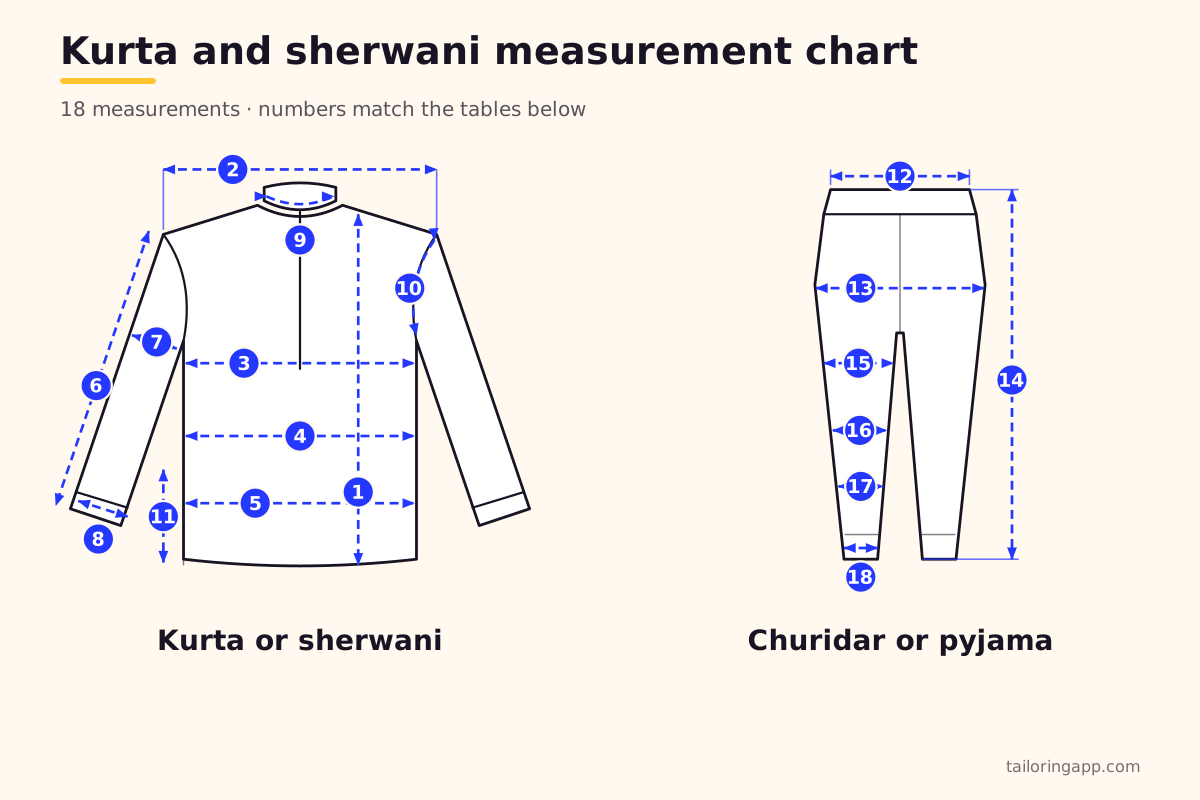
| # | Measurement | How to take it |
|---|---|---|
| 1 | Length | From the highest point of the shoulder, next to the neck, down to where the hem should fall. |
| 2 | Shoulder | Across the back, from one shoulder tip to the other. |
| 3 | Chest | Around the fullest part of the chest, under the arms. |
| 4 | Stomach | Around the fullest part of the stomach. On a sherwani, this decides whether the buttons sit flat. |
| 5 | Hip | Around the seat. A knee-length garment has to clear this comfortably when he walks and sits. |
| 6 | Sleeve length | From the shoulder tip, over a slightly bent elbow, to the wrist bone. |
| 7 | Bicep | Around the fullest part of the upper arm. |
| 8 | Cuff | Around the wrist or the sleeve opening he wants. |
| 9 | Neck | Around the base of the neck, with one finger under the tape. For a stand collar, also write the collar height, usually 1.25 to 1.75 inches. |
| 10 | Armhole | Around the arm at the shoulder joint, passing under the arm. |
| 11 | Side slit | From the hem up to where the slit should start. |
Churidar and pyjama measurements
| # | Measurement | How to take it |
|---|---|---|
| 12 | Waist | Around the place he wears it, usually at or just below the navel. |
| 13 | Hip | Around the fullest part of the seat, feet together. |
| 14 | Length | From the waist down to the ankle. A churidar is cut longer so it gathers; note how many gathers he wants. |
| 15 | Thigh | Around the fullest part of the upper thigh. |
| 16 | Knee | Around the knee, with the leg slightly bent. |
| 17 | Calf | Around the fullest part of the calf. |
| 18 | Ankle (mohri) | Around the ankle. His foot has to pass through it unless you add a zip or buttons. |
Also take crotch depth for a churidar or a fitted pant: seated on a flat chair, from the side of the waist to the seat. It is why some churidars feel fine standing and pull when he sits for the ceremony.
Lengths by style
Length is the first thing that changes a garment's look, so agree on it before you cut.
| Style | Where it ends | Usual length for a 5'8" man |
|---|---|---|
| Short kurta | Upper thigh | 30 to 34 inches |
| Regular kurta | Mid-thigh to above the knee | 36 to 40 inches |
| Long kurta | Knee and below | 42 to 46 inches |
| Sherwani | At or just below the knee | 42 to 46 inches |
| Achkan | Below the knee | 44 to 48 inches |
| Jodhpuri or bandhgala jacket | At the hip | 28 to 31 inches |
Write the exact number, not "knee length". The knee on a tall man is a different number from the knee on a short one.
Standard sizes
Use this table to check a number that looks wrong, or for ready stock. Brand charts differ, so it is not a replacement for measuring.
| Size | Body chest (inches) | Stomach | Shoulder | Sleeve | Neck |
|---|---|---|---|---|---|
| 36 (S) | 36 | 32 | 17 | 24 | 15 |
| 38 (M) | 38 | 34 | 17.5 | 24.5 | 15.5 |
| 40 (L) | 40 | 36 | 18 | 25 | 16 |
| 42 (XL) | 42 | 38 | 18.5 | 25 | 16.5 |
| 44 (XXL) | 44 | 40 | 19 | 25.5 | 17 |
| 46 (3XL) | 46 | 42 | 19.5 | 26 | 17.5 |
These are typical figures from several Indian charts, not a formal standard. Add to the stomach for a customer who carries his weight in front.
How much ease to add
| Garment | Chest ease | Stomach ease | Hip ease |
|---|---|---|---|
| Sherwani, fitted | 3 to 4 inches | 2 to 3 inches | 4 inches or more |
| Sherwani, with a kurta underneath | 4 to 5 inches | 3 to 4 inches | 5 inches or more |
| Kurta, regular | 5 to 7 inches | 5 to 6 inches | 6 inches or more |
| Kurta, loose or Pathani | 8 inches or more | 8 inches or more | 8 inches or more |
A sherwani has lining and sometimes heavy work, and both take up room. Embroidery can also stiffen the cloth so it no longer gives. Allow for this before the work starts, because you cannot let out an embroidered panel later.
How much fabric to ask for
Rough figures for a medium to large size. Lay it out before you promise, and allow more for a print or a border that has to line up.
| Garment | Fabric (about 44 inches wide) |
|---|---|
| Regular kurta | 2.5 to 3 metres |
| Long kurta | 3 to 3.5 metres |
| Sherwani | 3 to 3.5 metres, plus the same again in lining |
| Churidar | 2.5 to 3 metres (cut on the bias) |
| Straight pyjama | 2.25 to 2.5 metres |
| Stole or dupatta | 2.25 to 2.5 metres |
Wedding orders: booking the work
Sherwani orders fail on dates more often than on measurements. A sensible order of work:
- Booking, at least 4 to 6 weeks out. Take measurements, a design reference, an advance and the wedding date.
- First trial, without the work. A plain muslin or the unfinished garment. This is the time to fix shoulder and chest.
- Embroidery, after the fit is right. Work on a badly fitted panel cannot be saved.
- Final trial, about a week before the wedding. With the kurta, the churidar and the footwear.
- Delivery, a few days before the event. Never on the morning of the wedding.
Put these dates and the event date on the bill. Our tailor and boutique bill book designs have room for all of them.
When it does not fit: what to check
| Problem at the trial | Measurement to check |
|---|---|
| Buttons strain at the stomach | Stomach ease, or lining taking up the room. |
| Collar chokes when he sits | Neck too small, or collar too high. |
| Wrinkles across the back | Shoulder or the across-back width. |
| Cannot raise his arms for the garland | Armhole cut too low or bicep too tight. |
| Hem swings out at the front | Stomach is fuller than the pattern allows; lengthen the front. |
| Churidar will not go over the foot | Ankle. Add a zip or buttons at the ankle. |
| Churidar pulls when he sits | Crotch depth or thigh. |
Notes to write next to the numbers
- Style: kurta, sherwani, achkan, bandhgala or Nehru jacket.
- Collar: stand, band, height and whether it hooks.
- Closure: buttons, hidden placket, hooks, and who supplies the buttons.
- Lining: type and colour.
- Work: type of embroidery, where it goes and who is doing it.
- Bottom: churidar, straight pyjama, dhoti pant or pant.
- Event date, and the date of any function before it.
Keep the numbers for the whole family
A wedding rarely brings one customer. The groom's father, brothers and friends often all want matching kurtas, and half of them will come back next season.
In Tailoring App you set up the Kurta, Sherwani and Churidar pieces once with the fields from this chart. Each customer's numbers are saved with the date and up to three photos of the design. Trial and delivery dates show on the dashboard, so a wedding order never surprises you, and the embroidery karigar sees the job and the photos without seeing the customer's phone number or price. It is free for one person and 50 orders a month. See how it works for boutiques and for tailoring shops.
For the shirt and trouser side of the wardrobe, see the shirt and pant measurement chart.