 Tailoring App
Tailor measurement book format: free printable page for tailors and boutiques (A5 PDF)

Every tailor has a measurement book, and every tailor has lost time to one. A regular customer walks in and asks for the same blouse as last year. Then someone spends ten minutes turning pages, looking for a name that may be spelled differently, in a book that may be last year's.
A good measurement book solves this with a page format that is the same every time and a number that finds the customer. Below is a free page to print, what to put on it, how to set it up so you can find anyone in a minute, and what a boutique should add.
Download the measurement book page
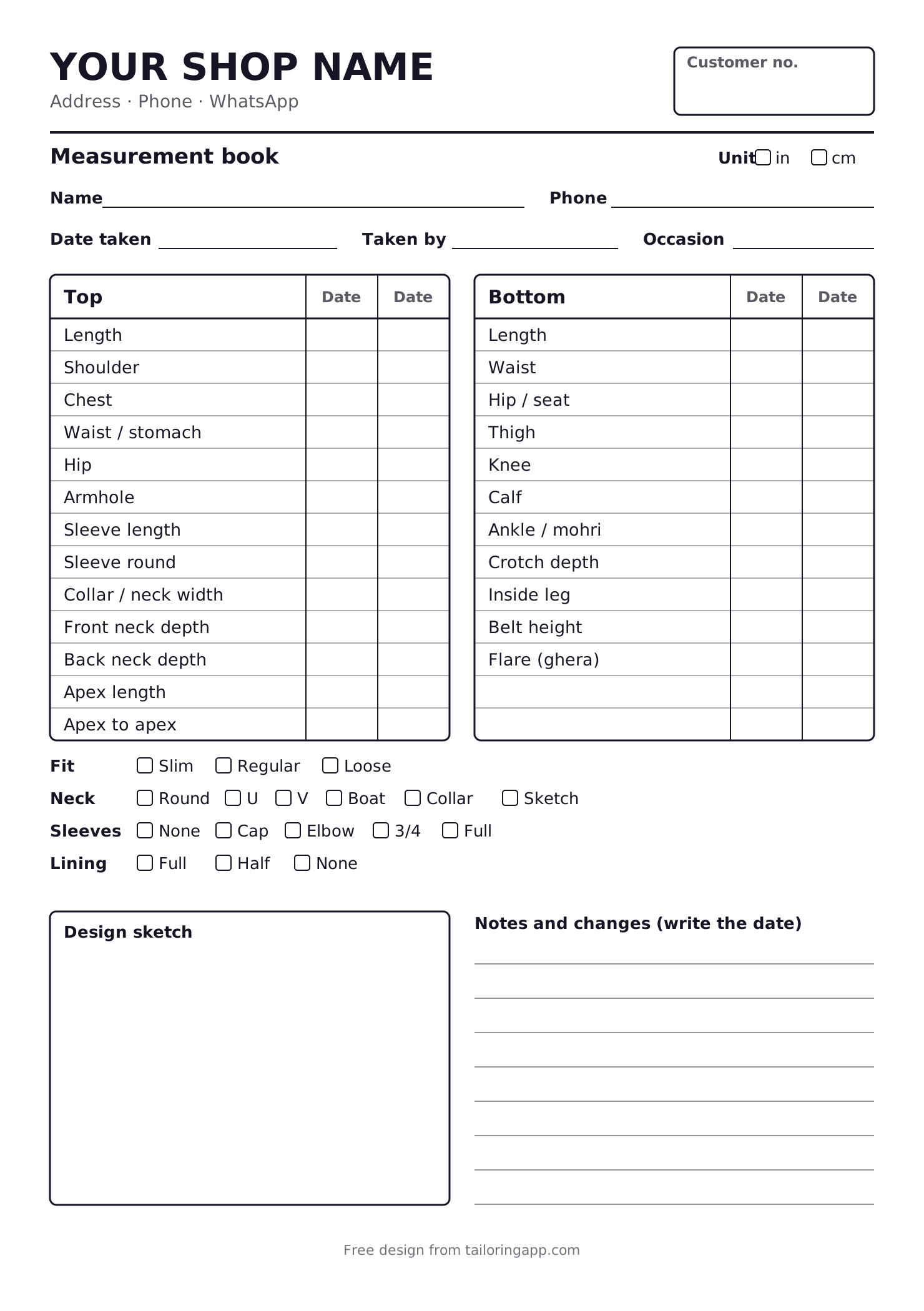
One A5 page per customer, with both a top and a bottom column, so it works for ladies and gents. It prints cleanly in black and white. Take the PDF to your printer to have it bound into a numbered book with your shop's name in place of the placeholder, or print single sheets at home and keep them in a file.
If you want a form for one kind of garment, we also have free printable forms with your shop's name on them: blouse, salwar kameez, shirt and pant, lehenga and kurta and sherwani.
What every measurement book page needs
- Customer number. The most important box on the page. See the next section.
- Name and phone number. The phone number is what stays the same; spellings do not.
- Date taken. Bodies change. A measurement from three years ago is a starting point, not a fact.
- Unit. Inches or centimetres, written on the page.
- Top measurements. Length, shoulder, chest, waist, hip, armhole, sleeve length and round, and neck depth.
- Bottom measurements. Length, waist, hip, thigh, knee, ankle or mohri, and crotch depth.
- Style notes. Neck, sleeve, lining, opening, fit. A tick box is faster than writing.
- A sketch box. A rough drawing of a neck design is worth more than a sentence.
- Who took it. So you know who to ask when the numbers look wrong.
- Space for changes. Do not cross out old numbers. Write the new one with the date.
How to find a customer in a minute
A book in date order only works if you remember when a customer came. Three simple habits fix that.
- Number every customer, not every order. Customer 1042 stays 1042 for life, across every order. Write it on the bill too.
- Keep an index at the front. A few pages, one per letter, with name, phone and customer number. It takes ten seconds to add a line, and it saves ten minutes every time someone comes back.
- Start a new book by range. When a book fills up, write "Customers 1001 to 1500" on the spine. Keep the old ones within reach, because old customers come back.
Write the customer number on the bill slip and the work slip, so a garment on the floor always leads back to the right page.
A separate book or a single book?
| Your shop | What works |
|---|---|
| Ladies tailor | One book, one customer per page, with a bottom column for suits |
| Gents tailor | One book, with shirt on the left and pant on the right |
| Both ladies and gents | Two books. The numbers and fields are different, and you will find people faster. |
| Boutique | One book, with a wider sketch box and a space for photo references |
What a boutique should add
A boutique's order lives on design details as much as on numbers. Add these to the page, or keep a design page facing it:
- Occasion and event date. A blouse for a wedding has a different deadline from an everyday suit.
- Trial dates. Two for bridal work.
- Fabric and embroidery notes. Who supplied the fabric, the work type and the area it covers.
- Photo references. A number that points to a folder on your phone, such as "1042, sister's wedding". This is the weak point of a paper book.
- Fit preferences. "Likes the blouse high at the back." The kind of note that keeps a customer coming back.
Where paper falls short
A paper book works, and plenty of good shops run on it. It has three real limits, and you will feel them as you grow.
- It is in one place. If the owner is at home and a customer calls, nobody can look up the numbers.
- It can be lost. A spill, a fire or a stolen bag can take years of customers. Take phone photos of the pages every month, at least.
- It shows everything to everyone. A karigar who picks up the book also sees your customers' phone numbers, which is how shops lose customers to their own staff.
From book to app
You do not have to copy an old book into an app. Keep the old book. When a customer comes back, add her then, and in a few months your active customers will be in without any data-entry weekend.
In Tailoring App you set up your garments and their measurement fields once. Each customer's numbers are saved with the date and up to three photos, and the next order starts from the last one, so you can see what changed. Search by name or phone instead of turning pages. Each karigar sees only the job and the numbers they need, not the customer's name or phone number. It is free for one person and 50 orders a month. See how it works for tailoring shops and for boutiques.
For how to take each measurement, see the charts for blouse, salwar suit and kurti, shirt and pant and lehenga. And for the bill that goes with the order, see our tailor and boutique bill book designs.